

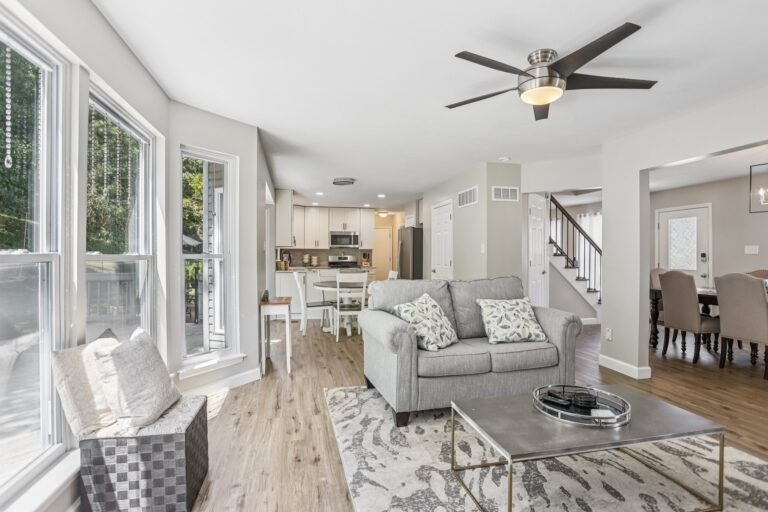
When sellers ask me how quickly their home should sell, I don’t think the most important
question is, “What’s the average days on market?”
I want to know what happens to the homes that don’t sell right away.
So I dug into recent MLS sales (the Month of August 2026 to be exact) in two of the markets
where I work most often, West St. Louis County and St. Charles County. I compared homes that
secured a contract within their first seven days on the market with those that took longer.
The pattern was remarkably similar.
In West County, homes that went under contract within seven days sold for an average of
104% of their original list price. Homes that took longer than a week averaged 99%.
In St. Charles County, the numbers were 103% for homes under contract within seven
days versus 99% for those that took longer.
And price wasn’t the only difference. The homes that didn’t secure a contract during that first
week also spent roughly five times longer on the market.
On a $500,000 list price, the difference between 104% and 99% is $25,000.
Now, that does not mean your house suddenly loses $25,000 on day eight. The data doesn’t tell
us that sitting on the market caused those homes to sell for less.
I think it tells us something more useful.
The homes that buyers responded to quickly were also the homes that performed better
financially.
In my experience, there are usually a few reasons why: price, condition, presentation, and
competition.
That’s why getting your house ready to sell isn’t about making it perfect. And it isn’t about
spending a fortune renovating before you list.
It’s about making sure your condition, presentation, and price tell the same story from day
one.
Those first few days are when your listing is new, buyer interest is highest, and the people who
have been waiting for a home like yours are most likely to see it. If buyers reject it during that
initial window because the price doesn’t match the condition, the presentation falls short, or
another home simply looks like a better value, getting that attention back later can be much
harder.
So before you start painting walls, replacing countertops, or making a list of everything you think
needs to be updated, let’s talk about what actually matters.
.
Your house doesn’t need to be the nicest. It needs to
make sense.
The first question isn’t, “What should I update?”
It’s, “What will buyers compare my house to?”
If similar homes in your neighborhood are selling with original kitchens and bathrooms, you may
not need to touch yours. If the homes getting the strongest prices have renovated kitchens,
newer flooring, updated bathrooms, and fresh paint, buyers are going to notice the difference.
That doesn’t automatically mean you should spend $50,000 trying to catch up.
Sometimes the smartest decision is to sell the home largely as it is and price accordingly. Other
times, spending a few thousand dollars on paint, flooring, lighting, landscaping, or targeted
repairs can dramatically improve how buyers perceive the home.
This is where local market knowledge matters.
A 1980s Ballwin home isn’t necessarily competing against the same buyer expectations as a
newer home in St. Charles County. A Wildwood property on acreage may be evaluated
differently than a home inside a subdivision. An established St. Charles County resale may even
be competing with brand-new construction offering builder incentives.
The question isn’t simply, “Is my house updated?”
It’s “What else can my likely buyer purchase for about the same amount of money?”
That’s the competition we need to prepare for.
A beautifully maintained original home at the right price can make sense. A fully renovated
home at a premium can make sense. Even a home that needs significant work can make sense
when the price reflects it.
The problem is when the condition, presentation, and price don’t agree.
Fix what can actually kill the deal
Before worrying about cabinet hardware or trendy light fixtures, I want sellers paying attention to
the issues that can create real concern during an inspection.
Water intrusion, roof and gutter problems, foundation concerns, HVAC, electrical issues,
plumbing problems, and other significant defects deserve attention first.
In parts of Wildwood and other areas with private systems, well and the condition of the septic
can belong on that list too.
That doesn’t mean automatically replacing every aging component. An older furnace that is
operating properly is very different from one showing signs of failure.
The goal is to know what you’re dealing with before the buyer’s inspector tells you.
Once you’re under contract, your options can become more limited. You’re negotiating against a
deadline, the buyer may suddenly be nervous about the house, and an issue that could have
been addressed before listing can become a much larger point of negotiation.
Knowing about potential problems in advance gives you choices. We can decide whether it
makes sense to repair something, disclose it, obtain estimates, or account for it in the pricing
strategy.
Minor items matter too, but differently. A scuffed wall, dated switch plate, or sticky door probably
won’t kill a transaction. A pattern of small neglected items, however, can make buyers wonder
what larger things haven’t been maintained.
Make the cosmetic improvements buyers actually notice
Once we’ve addressed anything that could materially affect the sale, I turn my attention to
presentation.
This is where relatively inexpensive improvements can have an outsized impact.
Fresh paint can completely change how buyers perceive an older home. Consistent lighting
makes rooms feel brighter and helps photography. Removing excess furniture can make a room
feel substantially larger without changing a single square foot.
I typically look closely at:
● Fresh or touched-up neutral paint where needed
● Worn or heavily dated flooring
● Consistent light bulbs and adequate lighting
● Decluttering countertops, closets, and living spaces
● Removing excess furniture
● Cleaning windows
● Fresh caulk and grout where needed
● Baseboards, doors, trim, and other areas that accumulate wear
● A true deep clean before photography and showings
None of those improvements sound particularly exciting.
But buyers don’t experience them individually. They walk into a house and think, “This feels
really well maintained.”
Or they don’t.
That feeling influences how they perceive the entire house, including what they think it’s worth.
Don’t underestimate what buyers see before they open
the front door
The buyer’s first showing doesn’t actually start when they walk inside.
It starts online.
Your exterior photo may be one of the first images they see. Then, when they arrive for a
showing, they’re standing outside looking at the house while their agent opens the lockbox.
That makes curb appeal especially important throughout West County and St. Charles County,
where many homes have larger yards, mature landscaping, prominent driveways, and
established subdivision streetscapes.
You don’t necessarily need an expensive landscaping overhaul.
Freshly cut grass, clean edging, trimmed bushes, fresh mulch, pressure washing where needed,
a cleaned-up front porch, and a front door that doesn’t look tired can go a long way.
Those details start telling the buyer the story of your home’s condition before they’ve ever seen
the kitchen.
Price is part of your home’s condition strategy
This is where all of these decisions come together.
You can sell a dated house.
You can sell a house that needs repairs.
You can sell a house with an original kitchen, worn flooring, or an aging HVAC system.
But buyers are going to compare its condition and price against their other choices.
Price, condition, and presentation have to work together.
If your house is beautifully updated and competing against inferior inventory, buyers may be
willing to push the price.
If it’s dated but exceptionally maintained, we can position it accordingly.
If it needs significant work, the price may need to create enough value for a buyer to be willing
to take that work on.
Problems happen when those three things don’t match.
A home needing substantial updating but priced alongside the beautifully renovated house down
the street doesn’t make buyers forget about the updates. It can make the renovated house look
like the better value.
And that’s where the first-seven-days data becomes so important.
The answer isn’t necessarily to price low.
The goal is to price accurately for the condition and competition, then make the home
look as strong as possible within that position.
We want buyers to recognize the value immediately rather than waiting several weeks for the
market to force a price adjustment.
Give yourself a real runway
Ideally, I like to start talking with sellers 30 to 60 days before they actually want their home
on the market.
Not because we need two months to prepare every house.
We may walk through yours and decide you need very little.
Starting early simply gives us choices.
We can identify repairs, get contractor estimates, decide whether an improvement makes
financial sense, declutter gradually, schedule painters or cleaners, prepare landscaping, and
make decisions based on strategy rather than urgency.
Most importantly, we can look at the actual competition before you spend money.
I’d much rather tell a seller not to spend $15,000 on something buyers aren’t likely to pay them
back for than walk in two weeks before listing and discover they’ve already done it.
And sometimes the advice really is: don’t replace it. Don’t renovate it. Don’t spend the money.
Let’s price and market the house we actually have.
The goal isn’t a perfect house. It’s a strong launch.
There is no universal list of things every seller in Ballwin, Wildwood, Ellisville, Chesterfield, St.
Charles, O’Fallon, or the surrounding communities needs to do before selling.
That’s exactly why I don’t love generic “25 things to do before listing your house” checklists.
Your home isn’t generic.
The right preparation depends on its condition, price point, neighborhood, competition, likely
buyer, and what is happening in the market right now.
The local numbers make the importance of that preparation even clearer.
In West County, homes securing contracts within seven days averaged 104% of original list
price compared with 99% for those taking longer. In St. Charles County, it was 103%
compared with 99%. The homes that didn’t secure that early contract also spent roughly five
times longer on the market.
That doesn’t tell us that day eight caused those homes to sell for less.
It tells us something much more useful:
The homes buyers responded to immediately were also the homes that performed better.
That’s why the goal isn’t to spend the most money preparing your house.
It’s to figure out where spending money could improve your outcome, where it won’t, and
how to position the home you have so buyers understand its value from day one.
If you’re considering selling in the next few months, I recommend starting with a walkthrough
before you start making improvements. We can look at your home, compare it to what buyers
are choosing right now, and build a preparation plan around the things most likely to matter
when you hit the market.
